




 Investing basics

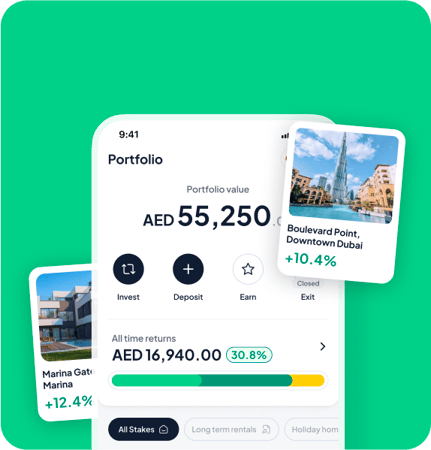
 Table of contents
Key takeaways
Fractional ownership lets you co-own prime real estate from AED 500 (about $150)
You earn two ways: weekly rental income and increasing property value
You can sell your share with Stake’s Exit Window, twice a year
What is fractional ownership?
Fractional ownership means you own a slice of a property alongside other investors, rather than buying the whole thing yourself.
It's similar to owning shares in one company - the ownership, risk, and return is shared by more than one person.
In real estate, a lot of people can't afford to buy a whole property or they don't want the hassle that property management brings. Properties are now split into shares that anyone can afford.
Deloitte's Center for Financial Services projects the value of tokenized and fractionalized real estate will grow from under $0.3 trillion in 2024 to roughly $4 trillion by 2035, a compound annual growth rate of about 27%. Private real estate funds and loan securitization moving toward fractional structures are driving most of that growth.
Fractional ownership let's you earn in 2 ways: weekly rental income and
How fast is fractional real estate set to grow?
According to Deloitte Center for Financial Services, fractional property is projected to grow to $4 trillion by 2035.
How does fractional ownership actually work?
Think of it like splitting a pizza with friends, where the more money you put in, the bigger the slice you get.
A group of investors collect money to buy a property together, and each person's share matches what they put in. A special purpose vehicle, or SPV, holds the property on everyone's behalf.
Fractional ownership gives you a percentage stake that earns rental income and moves with the property's value, whether you ever set foot in it or not.
What are the benefits of fractional property ownership?
You can start small
With Stake, you can invest in a fractional share from AED 500 (about $150), with no mortgage or down payment required.
Compare that to buying a Dubai property outright: many properties easily exceed AED 1 million ( around $270,000),.
Why does diversification matter?
With Stake, you can spread money across several properties instead of betting on one. That might mean different neighborhoods, different formats (short-term versus long-term rentals), or different property types altogether.
So if one investment slows down, the rest keep your portfolio moving forward.
How do you actually make money?
Fractional real estate pays out two ways: monthly rental income and long-term price appreciation.
Across the 42 properties that have gone through the full cycle, from funding to sale, the average property price increase was 33% over an average hold of just under 3 years.
These are completed results, money that reached investors, not projections or a promotional rate.
For the most recent detail, including a month-by-month breakdown, see how Dubai property performed in H1 2026 and the exits we completed.
How do you access liquidity?
Real estate has a reputation for being hard to exit, and fractional ownership make it easier.
There's 2 ways to exit:
Exit Window: Twice a year, you have the chance to sell your shares to other users.
Property sale (Exit): When your property sells, you get your share of profit from the sale.
Real estate is fundamentally a long-term investment, and we encourage investors to hold their investment for the full term.
What are the downsides of fractional property ownership?
Do you make every decision alone?
Co-ownership means co-decision-making. Investors vote on "material changes" to a property, which typically include:
- Selling the property
- Converting it into a short-term rental
- Changing the property manager
- Major maintenance work above 5% of the unit's value
Buying into a crowd-funded property means accepting that some decisions won't be entirely yours to make.
How liquid is this, really?
Exit tools like Sell with Stake and the Exit Window help, but they're not a substitute for a public exchange with continuous buyers and sellers.
How quickly you can sell, and at what price, still depends on demand from other investors on the platform for that specific property.
Can property values fall?
Yes, all investing carries risk. However, real estate tend to be less volatile compared to other assets like stocks and crypto.
Is this regulated?
Yes, Stake is registered in the Dubai International Financial Center (DIFC) and regulated by the Dubai Financial Services Authority (DFSA) in the UAE.
What happens after a property is funded?
-
We register the holding company. Once a property is fully funded, we set up a Special Purpose Vehicle (SPV) registered in the Dubai International Financial Centre (DIFC) to hold it on behalf of every investor in that deal.
-
The property gets registered under the SPV. The paperwork gets filed with the Dubai Land Department (DLD), which typically takes two to three weeks to complete.
-
You receive your title deed and share certificate. Once registration clears, you get a share certificate and a copy of the title deed by email, and both appear in your Stake portfolio. You can verify your ownership documents directly in-app.
-
You start receiving rental payments. The property is handed to a professional property manager, and your first rental payment typically lands in your Stake wallet by the end of that month.
Ready to start?
If fractional ownership fits how you want to invest, create a Stake account and browse available properties.
Start property investing from AED 500.
All Investments carry risks. Stake Properties Limited is regulated by the DFSA as an Operator of a Crowdfunding Platform in the UAE
Updated: September 2026
About the author
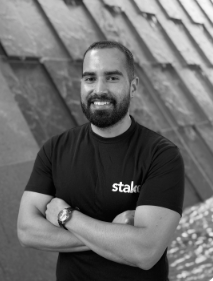
Mattias has spent his career reporting on and writing about regulated financial and business topics.
He began as a Market Reporter at Argus Media, covering commodities markets, before moving to International Tax Review (ITR) as a Senior Reporter, where he covered international tax policy. He went on to serve as Global Editor at Suppleye and News Editor at Global Data Review, before joining Grant Thornton, a global accounting, tax and advisory firm, as Content Manager.
He's now Senior Content Writer at Stake, a DFSA- and CMA-regulated fractional real estate investment platform operating across the UAE, Saudi Arabia and international markets, where his reporting and editorial background informs his writing on real estate, finance and investing.
: Mattias Cruz
Mattias Cruz
Senior Content Writer
.png?)