




 Investing basics

.png?width=800&height=450&name=tokenisation%20(1).png)
 Table of contents
"Fractional" and "tokenization" get used to describe similar things. What actually differs is how ownership gets recorded, and what that means for you day to day.
The idea both models share
Buying property outright requires more money than most people want to commit, or have available.
Fractional ownership solves that by dividing a property across many investors. If a property is worth AED 1,000,000, you might invest AED 10,000, own 1% of it, and earn your share of rental income and price appreciation over time.
Learn how fractional ownership works.
Both models work on this principle, the only difference is the structure behind your share.
How fractional ownership works
When you invest through the traditional model, you're buying a share in a company created specifically to hold one property. This is called an SPV, short for "special purpose vehicle": a company with a single job, owning one property on behalf of its investors.
Your ownership is recorded as a legal share in that company. It's a well-understood structure. It also has some natural limits: verifying your ownership means going through the organization that holds the ownership record, and selling your share is limited to set windows, or whenever the property itself sells.
How tokenized ownership works
First, what is tokenization? Learn more.
Tokenized ownership applies the same principle, but records it differently.
Instead of a share in a company, your ownership becomes a digital token: a verified record of what percentage of a specific property belongs to you, stored on a blockchain.
This token is called an Asset-Reference Virtual Asset (ARVA) and it is the Virtual Asset that represents the Real World Asset (RWA) aka the property.
How income actually reaches you
With both the traditional and tokenization models, rental income is collected by the property manager, held by the financially-regulated company, and distributed to investors at set intervals.
Side by side
| Traditional fractional | Tokenization | |
|---|---|---|
| What you own | A share in a special purpose vehicle (SPV) that holds the property | A digital record of your ownership of the property |
| Income distribution | At set intervals, processed by a financially-regulated company | At set intervals, processed by financially-regulated company |
| When you can sell | Set exit windows, often once or twice a year | Set exit windows, often once or twice a year, with potential for more liquidity as the technology develops |
What doesn't change
Neither model changes the investment itself.
In both cases, it's a real property with real tenants. Your return depends on rental income and how the property's value moves over time, exactly as it would with any property investment.
Both models carry the same underlying risk. All investing carries risk, and the value of your share or ownership can go down as well as up.
Property tends to be less volatile than other asset classes and has historically increased in value over the long term, though past performance doesn't predict future results.
Tokenization vs fractional?
Each structure has different characteristics worth understanding before investing.
Tokenizations records ownership on-chain, which allows for independent verification. It also could opens the door to more flexible trading of your ownership as platforms develop that infrastructure.
Fractional ownership operates under structures that have been in market longer, and is the model most established platforms currently use.
The decision comes down to which characteristics matter most to a given investor, and in either case, the underlying property, market, and platform are the starting point.
Want to learn more about fractional property investing?
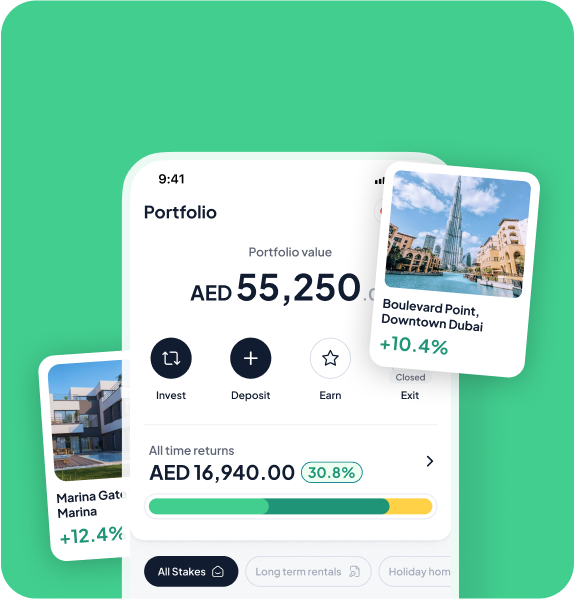
See how real estate fractional investing works. Open the app.
Stake RWA FZE holds an In-Principle Approval from VARA (Dubai) for Broker-Dealer Services; it is not yet licensed to provide these services and full licensing is not guaranteed. This content is educational only and is not an offer, solicitation, or advice to engage in any virtual asset activity. Virtual assets carry high risk of loss.
Updated: September 2026
FAQs
Got questions? See below for answers.
Need more help? Visit getstake.com or Help Center: https://help.getstake.com/en/
Yes. Tokenized ownership operates through regulated platforms and licensed structures, in the same way traditional fractional ownership does. The technology changes how ownership is recorded and the mechanics behind it.
Both carry the same underlying property market risk. The difference is in how ownership is recorded and verified, not in the risk profile of the property itself.
Tokenization doesn’t rely on paperwork and it simplifies cross-border ownership, slightly easing processes for international investors.
No. Many investors hold a mix of both, depending on the platform and property.
About the author
Mattias has spent his career reporting on and writing about regulated financial and business topics.
He began as a Market Reporter at Argus Media, covering commodities markets, before moving to International Tax Review (ITR) as a Senior Reporter, where he covered international tax policy. He went on to serve as Global Editor at Suppleye and News Editor at Global Data Review, before joining Grant Thornton, a global accounting, tax and advisory firm, as Content Manager.
He's now Senior Content Writer at Stake, a DFSA- and CMA-regulated fractional real estate investment platform operating across the UAE, Saudi Arabia and international markets, where his reporting and editorial background informs his writing on real estate, finance and investing.
Mattias Cruz
Senior Content Writer