




 Investing basics

.jpg?width=800&height=450&name=Kuwait%20to%20Dubai_%20Aerial%20Landmark%20Journey%20(1).jpg)
 Table of contents
You can own Dubai property from Kuwait without buying a whole unit. Fractional ownership lets you invest from AED 500 (about KD 42), and thousands of investors from Kuwait already invest this way with us.
Dubai is less than 2 hours' flight from Kuwait City, and getting there has always been the easy part. The harder part is everything after you decide to invest.
This guide covers why property in Kuwait is hard to get into, what buying a whole Dubai unit involves, and how fractional ownership changes it.
If you're ready, download the Stake app, complete verification, and you can make your first investment from AED 500.
At a glance
- Minimum investment: AED 500
- What you own: shares of a property
- Local tax on UAE rental income: none
- UAE residency needed: no
- Typical holding period: 3-5 years
Why is it hard to invest in property in Kuwait?
A typical home in Kuwait costs more than 15 times the average person's yearly salary, which puts it among the least affordable housing markets in the world. Research from the LSE Middle East Centre puts the average Kuwaiti house at KD 300,000, against an average monthly salary of KD 1,589.
Demographia, which ranks housing affordability worldwide, calls that level "impossibly unaffordable," and it puts Kuwait ahead of some of the world's most expensive cities.
| Market | Home price as a multiple of yearly income |
|---|---|
| Kuwait | More than 15 times |
| London | 13.3 times |
| New York | 10.2 times |
| San Francisco | 9.2 times |
That is a market where the first step onto the property ladder sits higher than most people can reach.
So for a Kuwaiti national, investing in property at home means one large purchase in an expensive market. For an expat, with rules around foreign ownership, it usually isn't an option at all.
Dubai removes both of those barriers.
Why do Kuwaiti investors buy property in Dubai?
Kuwaiti investors look at Dubai for rental income and a lower starting amount, but there are other benefits.
The UAE doesn't charge local income tax on rental earnings, stamp duty or capital gains tax on property.
How Dubai's market works matters too. As of Q2 2026, 57.6% of Dubai property purchases are paid upfront rather than with a mortgage, so interest rate rises affect prices less than in markets where most buyers borrow. This leads to a more stable market.
Dubai's population passed 4 million in 2025, growing 6-7% annually. This continuing population growth also supports demand for housing.
How to buy a whole property in Dubai from Kuwait?
Buying a whole unit from Kuwait means a large cross-border payment, paperwork, and then becoming a landlord from another country.
You choose a property and you work with a broker. You gather your documents: passport, civil ID and proof of funds. If you're not flying in to sign, you arrange a power of attorney, a legal document that lets someone sign on your behalf.
You then move a large sum across borders and keep every transfer receipt, because the Dubai Land Department (DLD), the government body that records property ownership, needs them to register the sale. You pay a deposit to reserve the unit, sign the sales agreement, pay the DLD registration fee and wait for ownership to transfer.
Then the real work starts: You own one property in one building in one neighbourhood, and you're a landlord from another country. Someone has to find a tenant, set the rent based on what similar units actually rented for rather than what they're advertised at, chase payments, handle repairs and renew leases.
When you want to sell, you go through the whole process again in reverse, and it can take months.
None of this means Dubai is a bad place to buy. It's just a lot of money, a lot of paperwork and a second job, all run from another country.
How does fractional property ownership work in Dubai?
Fractional ownership means a property is split between many investors, and each one owns exactly the share they paid for. With us, the minimum is AED 500.
Instead of putting hundreds of investors on one deed, each property is placed inside a special purpose vehicle (SPV), which is a company set up to own that one property and nothing else.
That company is registered in the Dubai International Financial Centre (DIFC), a financial zone in Dubai with its own courts and laws. The title deed is registered in the company's name at the DLD, and you own shares in the company.
You get 3 documents: a share certificate, your entry in the DIFC share register (the official list of the company's owners), and the title deed in the company's name.
You can check all 3 yourself without asking us, and step 7 below shows you how.
We find and screen tenants, set rents against real market data, handle renewals and look after maintenance.
Is investing in Dubai property with Stake halal?
Yes. Stake Properties Limited holds an Islamic Window licence from the Dubai Financial Services Authority (DFSA), which means our Shariah-compliant activity is directly supervised by the regulator.
The platform is also independently certified by Guidance Investments Sdn Bhd. A Shariah audit of our 2025 financial year, issued on 29 April 2026, confirmed we still met the conditions of that certification.
There's no riba (interest): your returns come from rent and from the property rising in value, not from interest charged on money. Investors share both the risk and the reward.
Fees and terms are shown up front, and the properties themselves are homes and commercial buildings.
How do I invest in Dubai property from Kuwait?
You can do every step from Kuwait, on your phone, without UAE residency. Here's the full process.
Step 1: Create your account
Download the Stake app or sign up online. It takes a few minutes. When you're asked, choose the UAE market, and you can switch between the UAE and Saudi Arabia at any point later.
Step 2: Verify your identity
Every regulated investment platform has to confirm who you are and where your money comes from. These are called KYC (know your customer) and AML (anti-money laundering) checks, and they're required by law.
You'll add your employment details, verify your identity with your passport or ID, and verify your address.
If you're in Kuwait, use the To Whom It May Concern certificate from the Public Authority for Civil Information, which you can download through the Sahel app.
If you upload the right documents, verification takes minutes.
You don't need UAE residency, and you don't need to be in Dubai.
Step 3: Add money to your wallet
You can invest only in AED, so Kuwaiti investors have to convert to AED during their bank transfer.
Investors frequently use Al Mulla Exchange to send funds to their Stake wallets, which can take a few days.
Once the transfer if completed, you’ll get a notification and email announcing that your Stake wallet has received funds.
Step 4: Choose a property
Pick a property by its strategy first, because that decides whether your return comes mostly from rent or from the eventual sale.
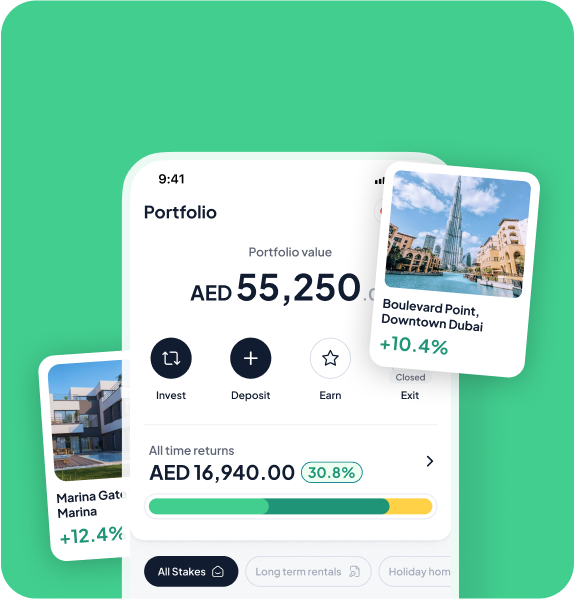
Every listing in the app shows the property's financials, an independent valuation, projected returns and which of our five strategies it follows.
| Strategy | What it does |
|---|---|
| High Yield | Buys properties with strong rental yield to maximise rental income |
| Capital Growth | Buys in areas with property value potential |
| Prime | Buys in established neighbourhoods that balance yield and capital growth |
| Fix n' Flip | Buys, renovates and sells |
| Fix n' Lease | Buys, renovates and keeps the property to rent out |
Step 5: Invest from AED 500
Choose how much to invest.
Investing in property has costs. If you bought yourself, it would total around 7-8% of the purchase price.
We try our best to lower these costs, but there are some fees we have to charge.
These are our fees:
| When | Fees |
|---|---|
| When you invest | 1.5% acquisition fee 0.2% one-off KYC/AML fee |
| Every year, from year two | 0.25% admin fee 0.1% KYC/AML fee |
| When the property sells | 2.5% exit fee |
Step 6: Receive your ownership documents
Once the property is fully funded, we set up the SPV, complete compliance checks, open its bank accounts and transfer the title deed.
You then receive your share certificate and title deed.
Step 7: Check your ownership yourself
This step is optional, and most investors skip it.
To check the title deed, open the Dubai Land Department's validation tool, select Validate Owner and Property, and enter the title deed number (found below the QR code), the year it was issued and the SPV name. For deeds issued in the DIFC, scanning the QR code checks it instantly.
To check your shares, go to the DIFC Public Register, select Non-Regulated Entities, enter the registration number from your share certificate and click View Profile. Your name should appear in the list of shareholders.
Step 8: Start receiving rental income
Your share of the rent lands in your Stake wallet every week, and you can withdraw it or reinvest it.
What’s the minimum withdrawal amount?
How do Kuwaitis specifically withdraw?
Step 9: Spread your money across several properties
One property in one building is a single bet. Several properties across different neighbourhoods and strategies is a portfolio, and it spreads your risk.
AutoInvest invests a set amount for you each month, from AED 500.
You pick a theme (Diversified, Growth-Focused or Income-Focused), and it invests automatically when matching properties are listed. It's free, and you can change or cancel it any time.
RentReinvest puts your rental income straight back into new properties, so your earnings start earning too. It's available once you reach our Plus tier, which means investing AED 5,000 within any 12-month period.
The app also gives you a Diversification Score out of 100, based on how spread out your money is across strategies, neighbourhoods and markets.
Step 10: Plan your exit before you invest
Plan to hold for 3-5 years, and know how you'll sell before you buy. The next section explains every route.
How do I get my money out?
The minimum withdrawal amount is AED 100.
You can withdraw your rental income whenever you like, but getting your original investment back needs a sale, and there are 3 ways that happens.
- Exit Windows are when you can sell your shares to other investors in the app, as long as you've held the property for at least a year. Your sale depends on another investor wanting to buy, and you can offer a discount to sell faster.
- A vote to sell can happen when a property has risen significantly in value or receives an offer. Every investor in that property votes before any sale goes ahead.
- Some strategies have one fixed exit by design. Fix n' Flip properties are sold after renovation and can't be exited early, because the unit is being worked on and earning no rent.
Treat this as a 3-5 year investment. Exit Windows give you some flexibility, but they aren't built for quick trading, and that's deliberate.
What does Stake's track record show?
As of October 2026, we've completed 42 exits, and those properties sold for around 33% more than they were bought for, on average, after being held for roughly 35 months.
| Stake platform data, August 2026 | |
|---|---|
| Properties funded | 673 |
| Completed exits | 45 |
| Dubai neighbourhoods | 43 |
| Total funded (UAE and Saudi Arabia) | AED 1.5BN+ |
| Paid to investors | AED 237M+ |
In the first half of 2026, we sold 14 properties across 8 Dubai neighbourhoods, with values up 31.6% on average. The fastest took just over a year and returned 52% in property values.
Start investing in Dubai from Kuwait
You don't need a flight or a broker to own Dubai property from Kuwait.
Download the Stake app, complete verification, and you can make your first investment from AED 500.
This article provides analytical insights for informational purposes only. It does not constitute financial advice. All investments carry risks. Past performance is not a reliable indicator of future results. Stake Properties Limited is regulated by the DFSA as an Operator of a Crowdfunding Platform in the UAE.
Updated: October 2026
FAQs
Got questions? See below for answers.
Need more help? Visit getstake.com or Help Center: https://help.getstake.com/en/
Dubai apartment prices have cooled in 2026 but have not crashed. According to REIDIN data across 40 areas, the city-wide average peaked in February 2026 and fell 4.2% by September. Prices stabilised month on month in August and ticked up in September.
Between January 2021 and September 2026, the city-wide average apartment price in Dubai rose from roughly 952 to 1,681 AED per square foot, an increase of about 77%. Every one of the 40 areas analysed appreciated over that period, though growth varied widely by neighbourhood.
DIFC led with 118.7% growth between January 2021 and September 2026, followed by Al Sufouh (+108.6%), The Greens (+108.4%) and Motor City (+106.7%). Several affordable areas, including Motor City and International City (+101.4%), outperformed many premium communities.
Premium and waterfront communities have seen the largest declines. Between February and September 2026, Palm Jumeirah fell 11.7%, Jumeirah 10.4%, Discovery Gardens 10.1% and Downtown Dubai 8.9%, which has created lower entry prices in some of the city’s most established areas.
The data points to consolidation rather than a crash. Comparing September 2025 with September 2026, the average year-on-year change across 40 Dubai areas is roughly -1.1%, with 14 areas still in positive territory. After five years of strong growth, a near-flat year gives fundamentals like rental demand and new supply time to catch up.
The data suggests Dubai’s apartment market has moved from a growth phase into a maturing phase. For investors, that may mean less emphasis on short-term price appreciation and more focus on rental income and choosing the right unit in the right area.
About the author
Mattias has spent his career reporting on and writing about regulated financial and business topics.
He began as a Market Reporter at Argus Media, covering commodities markets, before moving to International Tax Review (ITR) as a Senior Reporter, where he covered international tax policy. He went on to serve as Global Editor at Suppleye and News Editor at Global Data Review, before joining Grant Thornton, a global accounting, tax and advisory firm, as Content Manager.
He's now Senior Content Writer at Stake, a DFSA- and CMA-regulated fractional real estate investment platform operating across the UAE, Saudi Arabia and international markets, where his reporting and editorial background informs his writing on real estate, finance and investing.
Mattias Cruz
Senior Content Writer