




 Investing basics

 Table of contents
You have $10,000 today. In five years, will it still be worth $10,000?
Unfortunately, no. Inflation chips away at what your money can buy over time. The costs of goods and services goes up meaning the same amount of money buys less.
So how can you fight this? Find a way to ensure your money grows at the same rate as inflation to keep the same value, or make it grow faster to ensure you’re building wealth.
This is why people invest: investments can grow your wealth faster than prices rise.
Explore inflation-beating investments in the app.
So, what happens to your cash over 5 years? We'll compare 3 scenarios: keeping cash, investing in real estate without reinvesting, and investing in real estate with reinvestment.
Investing vs inflation: What happens to your money in 5 years
You have $10,000 today. In five years, will it still be worth $10,000?
Unfortunately, no. Inflation chips away at what your money can buy over time. The costs of goods and services goes up meaning the same amount of money buys less.
So how can you fight this? Find a way to ensure your money grows at the same rate as inflation to keep the same value, or make it grow faster to ensure you’re building wealth.
This is why people invest: investments can grow your wealth faster than prices rise.
Explore inflation-beating investments in the app.
So, what happens to your cash over 5 years? We'll compare 3 scenarios: keeping cash, investing in real estate without reinvesting, and investing in real estate with reinvestment.
Understanding the basics: Inflation and investment returns
Inflation
This is the rate at which prices increase over time. We'll use 3% annual inflation for our example calculations. This is modest compared to 5.67% average global inflation (2024).
Even at 3%, something that costs $100 today will cost $103 next year. The year after, it costs $106.09. Inflation compounds, meaning it builds on itself year after year.
Investment returns
This is the amount your money grows when you invest it. For real estate, we'll use 6% annual returns (for educational purposes), for reference average Dubai real estate ROI sits between 6-10%, depending on property and location. This could come from rental income, property appreciation, or a combination of both.
Scenario 1: Keeping $10,000 in cash
You keep your $10,000 in cash. The number stays at $10,000.
After 5 years, your $10,000 can only buy what $8,626 could buy when you started. You've lost $1,374 in purchasing power just by doing nothing.
Here's what this looks like:
| Year | Nominal value | Inflation factor | Real purchasing power | Loss from start |
|---|---|---|---|---|
| Start | $10,000 | 1.000 | $10,000 | $0 |
| 1 | $10,000 | 1.030 | $9,709 | -$291 |
| 2 | $10,000 | 1.061 | $9,426 | -$574 |
| 3 | $10,000 | 1.093 | $9,151 | -$849 |
| 4 | $10,000 | 1.126 | $8,885 | -$1,115 |
| 5 | $10,000 | 1.159 | $8,626 | -$1,374 |
Scenario 2: Investing $10,000 in real estate, without reinvesting
So what happens if you invest $10,000. You earn 6% annually in simple returns.
With simple returns and no reinvestment, you earn $600 per year on your original $10,000. You take this profit out each year instead of reinvesting it.
After 5 years, you've gained $1,217 after accounting for inflation. Your money can buy 12.2% more than when you started.
| Year | Nominal value | Inflation factor | Real purchasing power | Gain from start |
|---|---|---|---|---|
| Start | $10,000 | 1.000 | $10,000 | $0 |
| 1 | $10,600 | 1.030 | $10,291 | +$291 |
| 2 | $11,200 | 1.061 | $10,557 | +$557 |
| 3 | $11,800 | 1.093 | $10,798 | +$798 |
| 4 | $12,400 | 1.126 | $11,014 | +$1,014 |
| 5 | $13,000 | 1.159 | $11,217 | +$1,217 |
Scenario 3: Investing in real estate with reinvestment
What if you reinvest your profits instead of taking them out? This is where compounding creates serious wealth.
When you reinvest, your returns earn returns. Your $600 profit in year 1 gets reinvested, so in year 2 you're earning 6% on $10,600 instead of just $10,000.
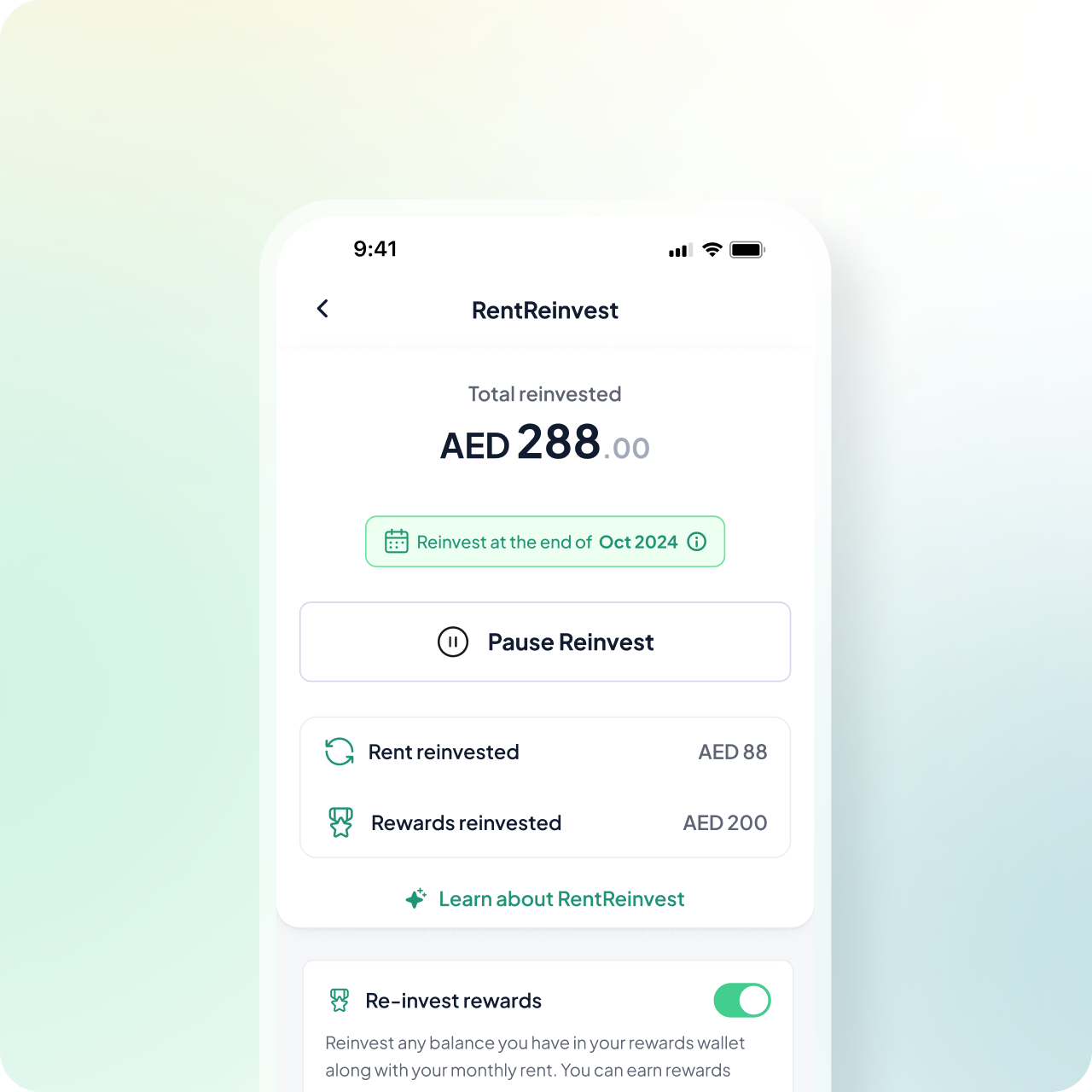
This is why we built RentReinvest, so you can make the most of your investment.
After 5 years, you've gained $1,547 in real terms. That's 15.5% growth in purchasing power.
| Year | Nominal value | Inflation factor | Real purchasing power | Gain from start |
|---|---|---|---|---|
| Start | $10,000 | 1.000 | $10,000 | $0 |
| 1 | $10,600 | 1.030 | $10,291 | +$291 |
| 2 | $11,236 | 1.061 | $10,590 | +$590 |
| 3 | $11,910 | 1.093 | $10,898 | +$898 |
| 4 | $12,625 | 1.126 | $11,213 | +$1,213 |
| 5 | $13,382 | 1.159 | $11,547 | +$1,547 |
Comparing all scenarios side by side
Let's put all three options together:
Keeping in cash:
- Nominal value: $10,000
- Real purchasing power: $8,626
- Change: -$1,374 (lost 13.7%)
Real estate without reinvesting:
- Nominal value: $13,000
- Real purchasing power: $11,217
- Change: +$1,217 (gained 12.2%)
Real estate with reinvesting:
- Nominal value: $13,382
- Real purchasing power: $11,547
- Change: +$1,547 (gained 15.5%)
Why real estate typically performs well against inflation
Real estate has built-in advantages that cash doesn't. Like all asset classes, real estate experiences market cycles, but it’s historically more steady than stocks and crypto.
Property values rise with inflation. As construction materials and labor get more expensive, existing buildings become more valuable.
Rental income grows over time. Your income stream increases while your initial investment stays the same.
It's a physical asset. People always need places to live and work. This creates stable demand regardless of market conditions.
You choose how to use returns. Take profits as income or reinvest for compound growth. Cash sitting in an account gives you neither option.
The 10-year view
The longer your money stays invested, the more powerful compounding becomes. Here’s how $10,000 performs over a full decade:
Cash at 3% inflation
- Real purchasing power: $7,441
- Change: –25.6%
- Your money loses a quarter of its value just by sitting still.
Real estate without reinvesting (6% simple annual returns)
- Nominal value: $16,000
- Real purchasing power: $11,906
- Change: +19.1%
Real estate with reinvesting (6% compound returns)
- Nominal value: $17,908
- Real purchasing power: $13,330
- Change: +33.3%
Across 10 years, the gap between doing nothing and letting compounding work for you is massive: a difference of $5,889 in real purchasing power.
And remember, 3% is conservative. If average inflation runs closer to what we saw in 2024 at 5.67%, your losses would be nearly double.
How to start
Stake lets you invest in real estate globally from AED 500. You get returns scaled to your investment size.
Build a diversified portfolio across handpicked properties and professional-grade funds. Collect monthly income and watch your property price grow.
The barriers to entry have never been lower. You don't need millions. You just need to start.
Ready to protect your money from inflation?
The figures used are for educational purposes and does not constitute investment advice. All Investments carry risks.
Stake Properties Limited is regulated by the DFSA as an Operator of a Crowdfunding Platform in the UAE and Stake Funds is regulated by the CMA as a Fund Distributor in KSA.
FAQs
Got questions? See below for answers.
Need more help? Visit getstake.com or Help Center: https://help.getstake.com/en/
At 3% annual inflation, $10,000 in cash loses about $1,374 in purchasing power over 5 years: meaning it can only buy what $8,626 could when you started. Over 10 years, cash loses roughly 25% of its value.
Simple returns mean you withdraw profits each year and earn only on your original investment. Compound returns mean you reinvest profits, so your returns earn returns. Over 5 years, compounding turns $10,000 into $13,382 vs $13,000 with simple returns, a $382 difference that grows significantly over time.
Property values rise as construction costs increase, rental income grows over time, and people always need places to live and work. This creates stable demand and built-in inflation protection that cash can't match.
At 6% compound returns, $10,000 grows to $17,908 nominally, or $13,330 in real purchasing power after inflation. That's a 33.3% real gain versus losing 25.6% by keeping cash.
Platforms like Stake allow fractional real estate investment starting from AED 500, making property investment accessible without needing millions upfront.
Reinvesting maximizes long-term wealth through compounding. Over 10 years, reinvesting returns can generate $1,424 more in real purchasing power compared to withdrawing profits annually.

About the author
The Stake Team is a trusted group of real estate and investment experts committed to delivering in-depth, data-driven insights for property investors in the UAE, Saudi Arabia, and beyond. Backed by years of industry experience, our team simplifies complex market trends, investment strategies, and more to help you make smarter decisions.
Stay informed with Stake.
Stake team