




 Market Insights

 Table of contents
Remember 2021? The vaccine had just started rolling out, travel was still half-shut and talk of a collapse was everywhere. The cautious move was to hold cash and wait for things to settle.
It turned out to be the last clearly low entry point for Dubai apartments.
Average property prices hit their lowest in January 2021, but by January 2026 they had surged 90% in 5 years (REIDIN, see methodology below).
People who held cash had a very different experience: global prices rose 34% over the same 5 years, meaning the value of cash fell through inflation.
Where AED 10,000 ended up
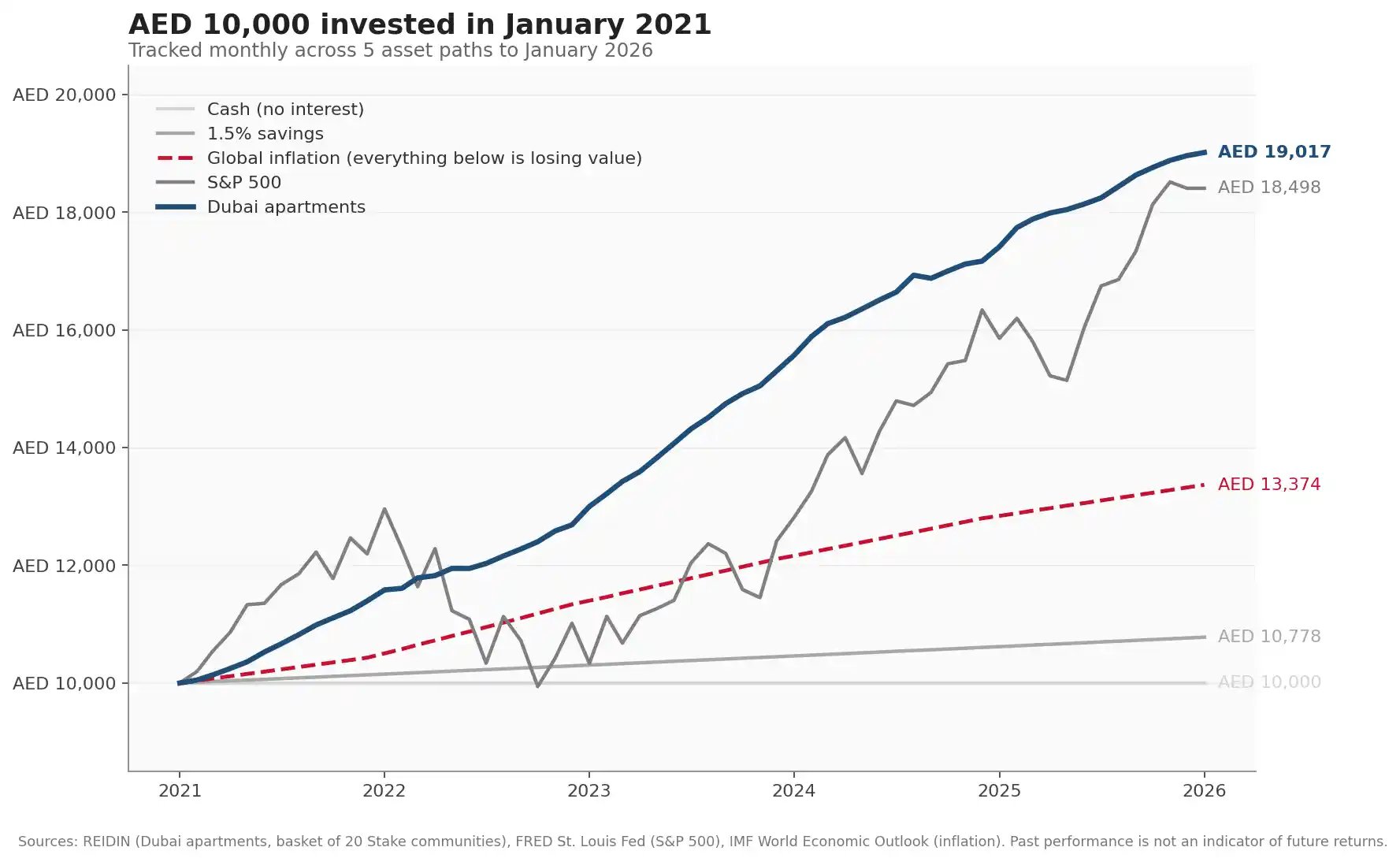
Where each AED 10,000 path taken in January 2021 ended up by January 2026:
| Asset | Value Jan 2026 | Real change |
|---|---|---|
| Cash, no interest | AED 10,000 | -25% |
| Low-interest savings at 1.5% | AED 10,778 | -19% |
| Global inflation curve | AED 13,374 | - |
| S&P 500 (value) | AED 18,498 | +38% |
| Dubai apartments, price only | AED 19,017 | +42% |
The red dotted row is the line that matters. AED 13,374 is what AED 10,000 needed to grow into just to keep its same value. Anything below it lost value as prices rose, anything above it built real wealth.
Cash and low savings rate finished below the line because they don’t create any or enough growth. Investing finished comfortably above it.
Buying windows never look certain
Look back at January 2021 today and in hindsight, the move looks obvious. Prices were depressed, while the long-term picture still looked strong. Anyone with cash and conviction would have got in.
However, at the time it was easy to see headlines and believed the ‘Dubai is finished’ narrative. The buying window was wide open, but not everyone could see that.
This is the pattern: buying windows close before the news catches up. By the time something feels certain, the cheap entry is gone.
The investors who captured the 2021 to 2026 run were just willing to deploy capital when conditions felt unreadable, but they believed in the long-term picture.
2 things the chart actually shows
1. Cash loses value over time
Cash and low-interest savings both finished below the inflation break-even. Owners ended the period with less real wealth than they started with. Doing nothing with your cash costs you real money.
2. Value-generating assets did the heavy lifting
The S&P 500 and Dubai apartments both outpaced inflation. The S&P 500 dropped to AED 9,666 during the October 2022 downward market before recovering. Dubai apartments climbed on a smoother trajectory, with rental income paying out monthly along the way.
What this means for the next 5 years
The 2021 entry point had clear signals: a global crisis, a clear price dip, a recovery that played out over long-term hold.
The IMF projects global inflation around 3.7% to 3.8% for 2026, while that's below the 2022 to 2024 peak, it means that your money has to grow more at 3.7-3.8% just to hold the same value. In 2026, conditions look quieter, more readable. Which is exactly the kind of moment when capital should be working, not waiting.
The investors who did best from 2021 to 2026 were people who showed up consistently, kept entry sizes manageable, and let time do the work.
Time in the market beats timing the market.
How we got these numbers
Every line on the chart, in 1 sentence each:
| Line | Source and method |
|---|---|
| Inflation | Cumulative annual world inflation from the IMF World Economic Outlook: 33.7% over 5 years. |
| Cash | AED 10,000 held flat. Real value = AED 10,000 ÷ inflation index = AED 7,479. |
| 1.5% savings | AED 10,000 compounded monthly at 1.5% per year. An illustrative midpoint of international savings rates over the period. |
| S&P 500 | Daily closes from the FRED S&P 500 series: 4 January 2021 (3,700.65) to 31 December 2025 (6,845.50). |
| Dubai apartments, capital | Simple monthly average of REIDIN's price-per-sqft index across 20 apartment communities. Basket: AED 1,022/sqft in January 2021, AED 1,944/sqft in January 2026. Capital growth: 90.2%. |
Real estate vs Stocks
Diversification is important and every asset class has it's pros and cons.
Property responds to longer-term supply and demand: construction pipelines, jobs and population growth. These change slowly. Investing in a single property can also be demanding, hold higher concentration risk, and exits are slower.
Equities, like the S&P500, are easy to buy and easy to sell. They move much faster, both up and down, which is great on the way up, but unsettling on the way down.
Stake provides a solution in between, more liquid than traditional real estate with our Exit Windows, fractional property investing allows your to spread your investment across multiple properties and exit if you need to.
Want to buy the dip in real estate?
As one of the biggest buyers of property in Dubai, we are constantly in the market. Our acquisitions team uses market-leading techniques to find properties with strong investment potential.
That’s why since 2021, we’ve exited 35 properties with an average 34% property price appreciation over 2.7 years.
And now, as recent data shows prices in some areas have softened and transactions have slowed, we are actively negotiation below-market price deals for our investors. You see these marked as below-market value in the Stake app.
If you sat on the sidelines in 2021, don’t miss the opportunity again. The dip is here, it’s your turn:
Explore the Stake app for up to 15% below-market deals.
This article provides analytical insights for informational purposes only. It does not constitute financial advice. All Investments carry risks. Stake Properties Limited is regulated by the DFSA as an Operator of a Crowdfunding Platform in the UAE.


.webp?)