




 Market Insights

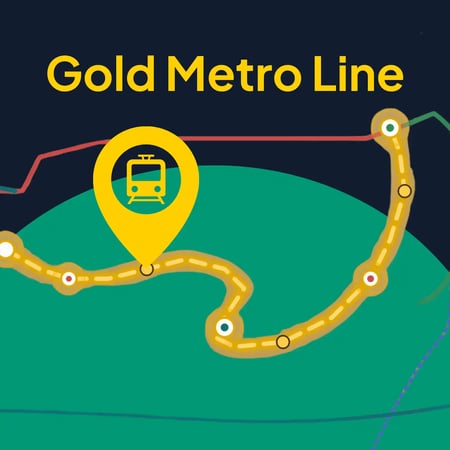
 Table of contents
Key takeaways
Dubai's new metro Gold Line opens September 2032
Past metro route areas outperformed Dubai's citywide price growth
Interchanges and areas with lower starting prices tend to gain most
Dubai has approved its largest transport project yet. The Metro Gold Line is a AED 34 billion, fully underground line spanning 42km across 15 strategic areas, with 18 new stations, and a tunnel network roughly twice the length of the existing Metro system.
It will serve around 1.5 million residents, connect with the Red Line, Green Line, and Etihad Rail, and support 55 major developments currently under construction. Completion is scheduled for 9 September 2032.
Infrastructure can lift the value of the areas it connects. The question for investors is where, by how much, and when.
Where the Gold Line runs
The route begins at Al Ghubaiba in Bur Dubai and ends at Jumeirah Golf Estates. In between, it runs through Mina Rashid, City Walk, Business Bay, Mohammed Bin Rashid City, Nad Al Sheba, Mohammed bin Rashid Gardens, Meydan, Al Barsha South, and JVC.
That is 11 publicly named areas across the confirmed 42km corridor. The remaining locations in the 15 strategic areas have not yet been individually named by the RTA.
The table below sets out each named area, its role on the line, and what it adds for investors.
| Area | Role on the line | Why it matters for investors |
|---|---|---|
| Al Ghubaiba (Bur Dubai) | Green Line interchange, start of route | Pulls historic Dubai into the modern network and connects directly to the Green Line |
| Mina Rashid | Waterfront destination | Active masterplan with residential, retail, and hospitality supply coming online |
| City Walk | Established urban district | High-footfall retail and residential area gaining direct metro access for the first time |
| Business Bay | Red Line interchange, employment hub | One of Dubai's largest commuting destinations, now a two-line interchange |
| Mohammed Bin Rashid City | Major residential masterplan | Dense residential zone getting direct metro connectivity rather than feeder-road dependence |
| Nad Al Sheba | Villa community | Established low-rise community moving from car-only access to metro access |
| Mohammed bin Rashid Gardens | Under-construction residential | Off-plan pipeline aligns with the line's opening window |
| Meydan | Etihad Rail interchange, events district | Gains both city metro and national rail access, lifting regional reach |
| Al Barsha South | Established residential | Large rental pool benefitting from a second route into the city |
| Jumeirah Village Circle (JVC) | High-density residential | One of Dubai's most populated communities |
| Jumeirah Golf Estates | Red Line and Etihad Rail interchange, end of route | Triple connection point anchoring the south-western end of the line |
Where the Gold line meets the rest of the metro network
Interchange stations carry disproportionate value. They increase the reach of the line they sit on, because a tenant or buyer at an interchange can reach more of the city without changing.
The Gold Line creates 4 confirmed interchange points:
- Al Ghubaiba connects to the Green Line
- Business Bay connects to the Red Line
- Meydan connects to Etihad Rail, the UAE's national passenger rail network
- Jumeirah Golf Estates connects to both the Red Line and Etihad Rail
Business Bay and Jumeirah Golf Estates become interchange stations for two lines. Meydan and Jumeirah Golf Estates become the two points where Dubai Metro meets Etihad Rail, which extends reach into Abu Dhabi and the other Emirates once the national network is complete
Why metro lines matter for property prices
In Dubai, where traffic can turn a commute into 45 minutes, that time saving is worth money. It widens the pool of tenants and buyers willing to consider an area. It makes homes easier to rent and easier to sell.
3 things tend to happen over time:
- Demand increases as more people find the area attractive
- Developers build more desirable projects around stations
- Units trade more often and sit on the market for less time
This is the accessibility premium: the increase related to well-connected locations once people factor convenience into what they will pay.
Do prices move before the line opens?
Often, yes. Markets tend to price in infrastructure ahead of completion, usually in waves: at route confirmation, during visible construction, in the 12 to 24 months before opening, and again after the line starts running.
The Blue Line, announced in November 2023, is the clearest recent example. In the 28 months since, areas on the route have shown a wide range of outcomes.
Apartment sales price per square foot moved as follows, according to REIDIN:
- Dubai Silicon Oasis: +70%
- International City: +56%
Over the same period, the typical Dubai apartment community saw sales prices rise 32%, according to the same data. Silicon Oasis and International City more than doubled the citywide rate.
The pattern is not uniform: proximity to a station, the existing quality of the area, and the starting price all matter.
It's worth noting that the low starting base in areas like International City has amplified the percentage move alongside the metro effect.
The broader point holds either way: areas on the line outperformed the citywide trend after the announcement, even before a single station has opened.
Waiting until the metro is finalised is usually too late to capture the stronger return potential. The opportunity sits in the middle, and in picking the right asset within the right area, at the right price.
Which areas along the Gold Line may benefit most
Not every station produces the same effect. Here are 4 scenarios:
Residential zones getting metro access for the first time
JVC, Mohammed Bin Rashid City, and Nad Al Sheba are residential areas that have historically relied on cars. Direct metro access is a material change for tenants and owners.
Access to employment hubs
Business Bay remains one of the largest commuting destinations in the city.
Properties within short walking distance of the station, particularly those built for professionals working in office areas have a logical uplift.
Interchanges
Business Bay, Jumeirah Golf Estates, and Meydan carry the highest potential network value.
Interchange points typically command the strongest accessibility premium, and Meydan and Jumeirah Golf Estates have the added layer of Etihad Rail access.
Established districts gaining another route
City Walk and Al Barsha South are already functional neighbourhoods with amenities and demand.
A direct metro stop adds convenience to areas that already work, which tends to translate into rents.
Where Gold Line areas stand today
The table below shows current apartment prices for the Gold Line areas where data from REIDIN is available. These are the starting-line numbers the announcement is pricing in.
| Area | Apartment sales (AED/sqft) | Apartment rent (AED/sqft/year) |
|---|---|---|
| Business Bay | 2,211 | 143 |
| Meydan City | 1,908 | 110 |
| Jumeirah Village Circle | 1,429 | 111 |
Business Bay and Meydan already sit at the upper end of Dubai's apartment market, which limits the upside compared to lower-base areas. JVC starts from a meaningfully lower base, which is one reason it tends to feature in infrastructure-led plays.
JVC is expected to see a large wave of new residential units handed over over the next 2 years, so the existing infrastructure would have struggled to serve the growing population - showing that Dubai’s long-term planning includes public infrastructure.
Not all areas will move the same
Being on a metro line is not the same as benefiting from it. 3 filters matter:
- Properties more than a 15-minute walk from a station capture much less of the premium
- Areas with weak amenities do not suddenly become desirable because a train stops nearby
- Segments with a lot of new supply may see demand growth absorbed by new units rather than flow into prices
Selectivity still matters.
What investors should watch from here
The Gold Line is a 7-year runway. Completion is scheduled for September 2032. That is enough time for prices to move and move again.
Five things worth tracking:
-
The 4 remaining strategic areas not yet named publicly by the RTA
-
Walking distance to a station, measured in minutes on foot rather than 'near the line'
-
The existing quality of each area, including amenities, schools, and walkability
-
Rents and occupancy, not just asking prices
-
The supply pipeline around each station
Infrastructure is a signal, not a guarantee
Transport-led growth is real. The best-positioned assets tend to be those where connectivity removes a genuine barrier, the surrounding area already has something to offer, and supply is tight enough for demand to show up in prices.
The Gold line is a bonus, but the work is still in choosing the right asset.
Ready to invest in Dubai properties? Explore the Stake app.
This article provides analytical insights for informational purposes only. It does not constitute financial advice. All Investments carry risks. Stake Properties Limited is regulated by the DFSA as an Operator of a Crowdfunding Platform in the UAE.
FAQs
Got questions? See below for answers.
Need more help? Visit getstake.com or Help Center: https://help.getstake.com/en/
The Gold Line is scheduled for completion on 9 September 2032. It runs 42km fully underground, with 18 stations from Al Ghubaiba in Bur Dubai to Jumeirah Golf Estates, and a tunnel network roughly twice the length of the existing Metro.
The publicly named areas are Al Ghubaiba, Mina Rashid, City Walk, Business Bay, Mohammed Bin Rashid City, Nad Al Sheba, Mohammed bin Rashid Gardens, Meydan, Al Barsha South, Jumeirah Village Circle, and Jumeirah Golf Estates. 4 more areas form part of the 15 strategic locations confirmed by the RTA but have not been individually named yet.
The Blue Line is the most recent reference point. In the 28 months since its November 2023 announcement, apartment sales prices rose 70% in Dubai Silicon Oasis and 56% in International City, according to REIDIN. The citywide apartment community average over the same period was 32%. Lower-base areas tend to amplify the percentage move, but the broader pattern of route areas outperforming the citywide trend held even before a station opened.
The line has 4 confirmed interchanges. Al Ghubaiba meets the Green Line, Business Bay meets the Red Line, Meydan meets Etihad Rail, and Jumeirah Golf Estates meets both the Red Line and Etihad Rail. Meydan and Jumeirah Golf Estates are also the two points where Dubai Metro connects to the UAE's national rail network, extending reach into Abu Dhabi and the other Emirates.
4 groups stand out. Residential areas getting metro access for the first time (JVC, Mohammed Bin Rashid City, Nad Al Sheba). Employment hubs like Business Bay where commuters drive demand. Interchange stations (Business Bay, Meydan, Jumeirah Golf Estates) which carry the strongest accessibility premium. And established districts gaining a second route in (City Walk, Al Barsha South). Walking distance to the station, area quality, and the local supply pipeline matter as much as being on the line.
3 questions to run through: Is the property priced fairly relative to comparable units in the same area? Does it have strong income potential? Am I deciding based on data or on emotion? If the answers hold up, the macro timing matters less than most investors assume.

About the author
Mattias has always held a passion in writing, starting professionally in 2018. Having started out as a business journalist and then moving into Marketing, his expertise covers a range of topics, including Real Estate, Finance & Investing, Technology, Data & Tax.
: Mattias Cruz
Mattias Cruz
Senior Content Writer