





 Investing basics

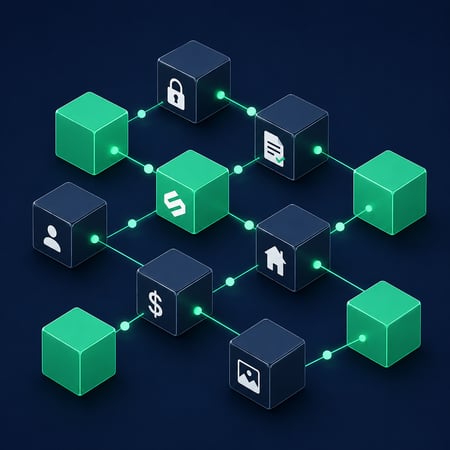
 Table of contents
If blockchain makes you think of crypto trading, that link makes sense. But the underlying technology is something separate, it’s a digital database that can be verified at any time.
What is a blockchain? Think of a blockchain like a shared record book that thousands of computers around the world each hold a copy of at the same time, instead of one company keeping "the" official version.
When something new happens (like a purchase), the computers check with each other and agree it's valid before adding it as a new "block" onto the chain. Because everyone has a matching copy, no one can secretly alter old records, if someone tried, their copy just wouldn't match everyone else's.
A shared record book, not a single ledger
Imagine a notebook that records who owns what. Normally, one entity keeps it: a bank, a government office, a company.
Everyone else trusts that it's being kept accurately, and that the record won't be lost or quietly changed.
A blockchain works differently. Instead of 1 notebook in 1 place, many identical copies exist across different computers. When something new is added, say, a record that someone now owns a share of a property, most computers on the network check it and agree it's correct before it's written in.
Once it's in the record, it's almost impossible to change. You'd have to take over most of the network's computers at once, the more computers there are, the harder that gets. That's why blockchain records are hard to fake or lose.
Why this matters for property investment
Ownership is checkable, not just claimable
Because the record sits across many computers, no single party can unilaterally rewrite it. You don't have to take an organization’s word for it, you can confirm ownership independently.
Records are hard to tamper with
Paper records can be misfiled, damaged, or changed without a trace. Traditional property records carry the same risk: 1 database, held by 1 authority, is a single point of failure.
A blockchain record, once written, almost never can be changed or deleted, and any attempt to alter 1 copy is rejected by every other copy on the network.
For a property investor, that means a permanent, tamper-resistant record of which tokens you hold.
Small transactions become economical
Blockchains can process many transactions quickly and cheaply because digital receipts are easier to transfer when ownership changes.
That matters when a property has hundreds of investors, each receiving a share of monthly rental income.
Different blockchains for different purposes
Not every blockchain is built for the same purpose. Bitcoin, one of the earliest, was designed as a form of digital currency.
Other blockchains are built for speed and low transaction cost. That matters for tokenized property.
What is tokenization for real estate? Learn more here.
A platform with hundreds of investors receiving monthly rental income needs to process a lot of small transactions quickly and cheaply.
What blockchain doesn't do
Blockchain doesn't make a property worth more and it doesn't remove normal property market risk. And it doesn't replace the need for a regulated platform standing behind the investment.
What it changes is how ownership is recorded: you can share it, check it independently, and it's very hard to tamper with.
Want to learn more?
See how fractional property investing works for you. Open the app.
Stake RWA FZE holds an In-Principle Approval from VARA (Dubai) for Broker-Dealer Services; it is not yet licensed to provide these services and full licensing is not guaranteed. This content is educational only and is not an offer, solicitation, or advice to engage in any virtual asset activity. Virtual assets carry high risk of loss.
Updated: September 2026
FAQs
Got questions? See below for answers.
Need more help? Visit getstake.com or Help Center: https://help.getstake.com/en/
No. Blockchain is the record-keeping technology behind your investment, not an asset you're buying. You never need to hold, trade, or understand crypto to invest.
Yes. The blockchain records ownership, but the legal protections behind your investment come from the regulated platform and structure you're investing through.
No. It works alongside it. The technology changes how ownership is recorded and verified, not the oversight that protects investors.
Ownership records on the blockchain can be independently verified, but that's different from being publicly broadcast with your identity attached. Platforms typically manage what's visible and to whom.
About the author
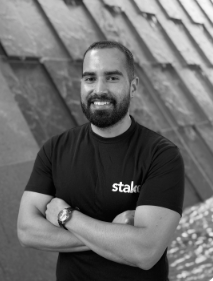
Mattias has always held a passion in writing, starting professionally in 2018. Having started out as a business journalist and then moving into Marketing, his expertise covers a range of topics, including Real Estate, Finance & Investing, Technology, Data & Tax.
Mattias Cruz
Senior Content Writer

.png?)