





 Investing basics

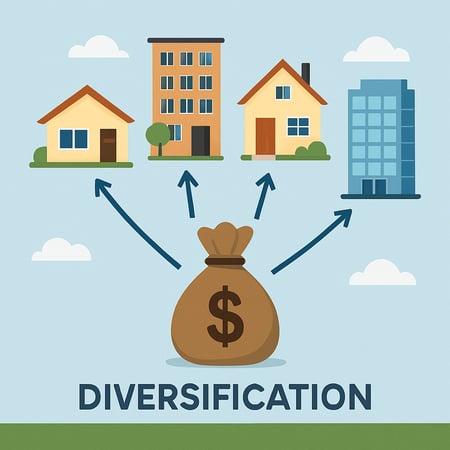
 Table of contents
Key takeaways
Diversification is a strategy to reduce portfolio risk
When one market slows, another keeps pace
Regular portfolio reviews are essential
You can check your Diversification Score in the Stake app.
What is diversification?
Diversification is a risk management strategy that mixes different investments within a portfolio, to reduce exposure to any single asset. The goal is straightforward: when one investment falls in value, others can offset the loss.
The concept traces back to a simple proverb you've heard since childhood: don't put all your eggs in one basket. If you drop that basket, you lose everything. Spread your eggs across multiple baskets, and a single drop won't wipe you out.
In financial terms, diversification refers to owning investments that don't all respond in the same way to market conditions. A diversified portfolio might include properties across different neighbourhoods, funds targeting different strategies, and assets spread across multiple markets. When one area struggles, another can carry the load.
The logic behind this approach is backed by decades of research. A portfolio constructed of genuinely different assets will, on average, deliver more consistent returns and lower risk than any single investment held alone.
How does diversification work?
Diversification works through correlation: how different investments move in relation to each other.
When two investments have a high positive correlation, they tend to rise and fall together. Owning both provides little protection because they respond in the same way to market forces.
When two investments have low or negative correlation, they move independently or in opposite directions. Combining them better protects your portfolio's overall performance.
Here's a practical example:
Imagine you invest entirely in several beachfront holiday rentals. When tourism booms, you profit. When travel declines: due to economic downturns, pandemics, or shifting consumer preferences, your entire portfolio suffers simultaneously.
Now imagine you also own residential properties in areas with strong employment growth, plus a fund invested in logistics warehouses benefiting from e-commerce expansion.
Tourism decline might hurt your holiday-focused rentals, but residential demand could hold steady while warehouse demand actually increases. Your overall portfolio remains stable because these investments respond to different economic forces.
This is diversification at work. The positive performance of some investments neutralises the negative performance of others.
Why is diversification important?
Diversification matters because markets are unpredictable, and concentration - the opposite of diversification - amplifies both gains and losses.
Concentration feels great on the way up: If you invest everything in a single booming asset and it doubles, you feel like a genius, however it's a different story on the way down.
No one can consistently pick winners: Last year's top performer doesn’t do as well the next year. [Studies](https://alphaarchitect.com/survivorship-biases/#:~:text=Chasing the performance of the best performing,among individual CTAs tends to lack persistence.) show that the best-performing asset class in one year is rarely the best performer the following year.
Rather than trying to somehow outsmart or predict the market, diversification ensures you participate in gains wherever they occur.
It protects against the unknown: Regulatory changes, conflicts, economic shifts, natural disasters, and industry disruptions are events that surprise everyone eventually. Diversification is insurance against risks you can't foresee.
It helps you stay invested: The biggest threat to long-term wealth isn't missing a hot opportunity. It's suffering a catastrophic loss that forces you to sell at the worst time or abandon investing altogether. Diversification keeps you in the game long enough for compounding to work.
Diversification strategies
True diversification can be achieved in different ways. Owning "different things" isn't enough if those things all behave the same way.
Asset class diversification
Asset classes are broad categories of investments with distinct characteristics: stocks, fixed income, real estate, commodities, and cash equivalents. Each responds differently to economic conditions.
Real estate tends to provide steady income and inflation protection. Bonds offer stability and predictable returns. Stocks deliver growth potential with higher volatility. Commodities can hedge against inflation. Mixing asset classes means your portfolio isn't dependent on any single economic outcome.
Geographic diversification
Different regions respond to different economic forces. A property market cooling in one city might coincide with growth in another. Regulatory changes affect locations differently. Currency movements create varying impacts across borders.
Owning three properties in the same neighbourhood isn't diversification, it's concentration disguised as variety.
True geographic diversification spreads investments across different markets = local problems remain local, and don’t negatively affect your portfolio.
Sector diversification
Within any asset class, different sectors face different risks and opportunities. In real estate, residential properties behave differently from industrial ones. Apartments in Downtown Dubai are affected differently to warehouses in the US.
Spreading across sectors protects against industry-specific downturns.
Strategy diversification
Investment strategies target different outcomes. Income strategies, like High Yield, prioritise steady cash flow from rentals or dividends. Growth strategies, like Capital Growth, target capital appreciation over time. Value strategies seek underpriced assets, like Fix n’ Flip.
Each strategy performs differently under different market conditions. A portfolio concentrated in a single strategy is exposed to that strategy's specific risks.
Mixing strategies creates balance.
Benefits of diversification
Reduces portfolio risk By spreading investments across assets that don't move together, diversification lowers the chance that your entire portfolio declines simultaneously. You're protected against isolated failures without avoiding investment altogether.
Smooths returns over time Diversified portfolios experience less dramatic swings than concentrated ones. You may not capture the full upside of a single winning investment, but you also avoid the full downside of a losing one. This consistency makes long-term planning more reliable.
Removes the pressure to predict When your success depends on picking winners, every decision feels high-stakes. Diversification removes this pressure. You don't need to correctly forecast which market, sector, or strategy will outperform. You simply participate broadly.
Supports better decision-making Concentrated portfolios trigger emotional reactions. When everything depends on one outcome, every piece of news feels urgent. Diversification creates breathing room, allowing rational decisions instead of reactive ones.
Provides flexibility A diversified portfolio gives you options. You can rebalance allocations, adjust strategies, or respond to life changes without completely restructuring your holdings.
Risks and limitations of diversification
Diversification is powerful but not perfect. Understanding its limitations helps you use it effectively:
It cannot eliminate all risks
It requires ongoing attention
It prioritises consistency
How to diversify your investment portfolio
Assess your current holdings
Start by examining what you already own. Look beyond names and platforms to underlying characteristics:
- What strategies are represented?
- Which geographic markets?
- What asset types?
Most investors discover more concentration than expected. This insight guides your next steps.
Identify gaps and overlaps
Where are you overexposed? Where are you missing coverage entirely? These gaps represent your greatest opportunities for risk reduction.
Define your target allocation
Based on your risk tolerance, investment timeline and financial goals, determine your ideal mix. Younger investors with longer horizons might tolerate more concentration in growth-oriented assets. Those approaching retirement might prioritise stability and income. There's no universal formula, only what works for you.
Rebalance periodically
Review your portfolio at least annually. When allocations drift from targets, rebalance by trimming positions that have grown and adding to those that have lagged.
Common diversification mistakes
Confusing quantity with quality: Owning ten similar investments isn't diversification. Ten stocks in the same market or accounts across multiple platforms holding equivalent assets, none of this provides meaningful protection. Genuine diversity requires genuine differences.
Ignoring correlation: Two investments might appear different but behave identically in practice. If everything in your portfolio responds the same way to interest rate changes or economic shifts, you're concentrated regardless of how many holdings you own.
Diversifying once and forgetting: Markets move continuously. Allocations drift. A portfolio that was well-diversified three years ago might be concentrated today. Regular monitoring matters.
How to measure portfolio diversification
Measuring diversification helps you understand where you stand and what to do next.
If you're investing with Stake, we've simplified this process. Your Diversification Score unlocks insights into your portfolio based on your unique investments across markets, neighborhoods, and strategies. Scores range from 0 to 100, with ratings for each component guiding your next investment decision.
It's about clarity; the best investment decisions come from understanding where you actually stand.
Check your Diversification Score in the app →
This blog provides general information about diversification as an investment concept. It does not constitute financial advice or a recommendation to buy, sell, or hold any investment. All investments carry risk. Stake Properties Limited is regulated by the DFSA as an Operator of a Crowdfunding Platform in the UAE.
FAQs
Got questions? See below for answers.
Need more help? Visit getstake.com or Help Center: https://help.getstake.com/en/
Diversification means spreading your investments across different assets so your entire portfolio isn’t dependent on one outcome. Instead of relying on a single property, market, or strategy, diversification reduces risk by ensuring that when one investment underperforms, others can help offset the impact.
Real estate markets don’t move in sync. Demand for residential properties, logistics warehouses, or holiday rentals can rise and fall for very different reasons. Diversification helps protect investors from market shocks, regulatory changes, or sector-specific downturns that could otherwise impact an entire portfolio at once.
Not necessarily. Owning several properties in the same neighbourhood or targeting the same tenant profile is still concentration. True diversification comes from investing across different locations, property types, and strategies so your portfolio isn’t exposed to a single economic or market risk.
Different regions respond differently to economic conditions, regulations, and demand cycles. A slowdown in one city or country doesn’t always affect others in the same way. Geographic diversification helps keep local issues from becoming portfolio-wide problems.
A common mistake is assuming that more investments automatically mean more diversification. If assets move the same way during market changes, they don’t provide real protection. Another mistake is diversifying once and never reviewing the portfolio, even as market conditions and asset values change over time.
The most effective way is to look beyond asset names and assess how your investments behave across markets, locations, and strategies. Tools like a Diversification Score help investors see concentration risks clearly and identify gaps, making it easier to make informed decisions rather than relying on guesswork.

About the author
Mattias has always held a passion in writing, starting professionally in 2018. Having started out as a business journalist and then moving into Marketing, his expertise covers a range of topics, including Real Estate, Finance & Investing, Technology, Data & Tax.
Mattias Cruz