




 Stake 101

 Table of contents
Key takeaways
The US-Iran peace deal ends a conflict that weighed on Dubai sentiment
The market continued, recording AED 252 billion in Q1 2026
The entry window is still open, but it will not stay open forever
Dubai real estate kept going and transacted AED 28.5 billion in May alone, during a regional war. Here's what happens to the property market now it's over.
The past few months have tested a lot of people's conviction, understandably.
Fortunately, the US and Iran have reached an agreement and trade routes are reopening. The conflict that dominated headlines since February is, at last, moving toward resolution.
I want to share what I am seeing, what the US-Iran peace deal means for Dubai real estate, and why I am optimistic.
What just happened
On June 14, the US and Iran announced an agreement and reopened the Strait of Hormuz. The deal ends a months-long blockade that had cut crude tanker transits through the world's most critical energy trade route.
It’s important to note, this is a framework agreement, not a final resolution. A 60-day negotiation window follows, covering key terms.
But the direction has changed, this is what moves markets as confidence rebounds.
What happened to Dubai property during the conflict
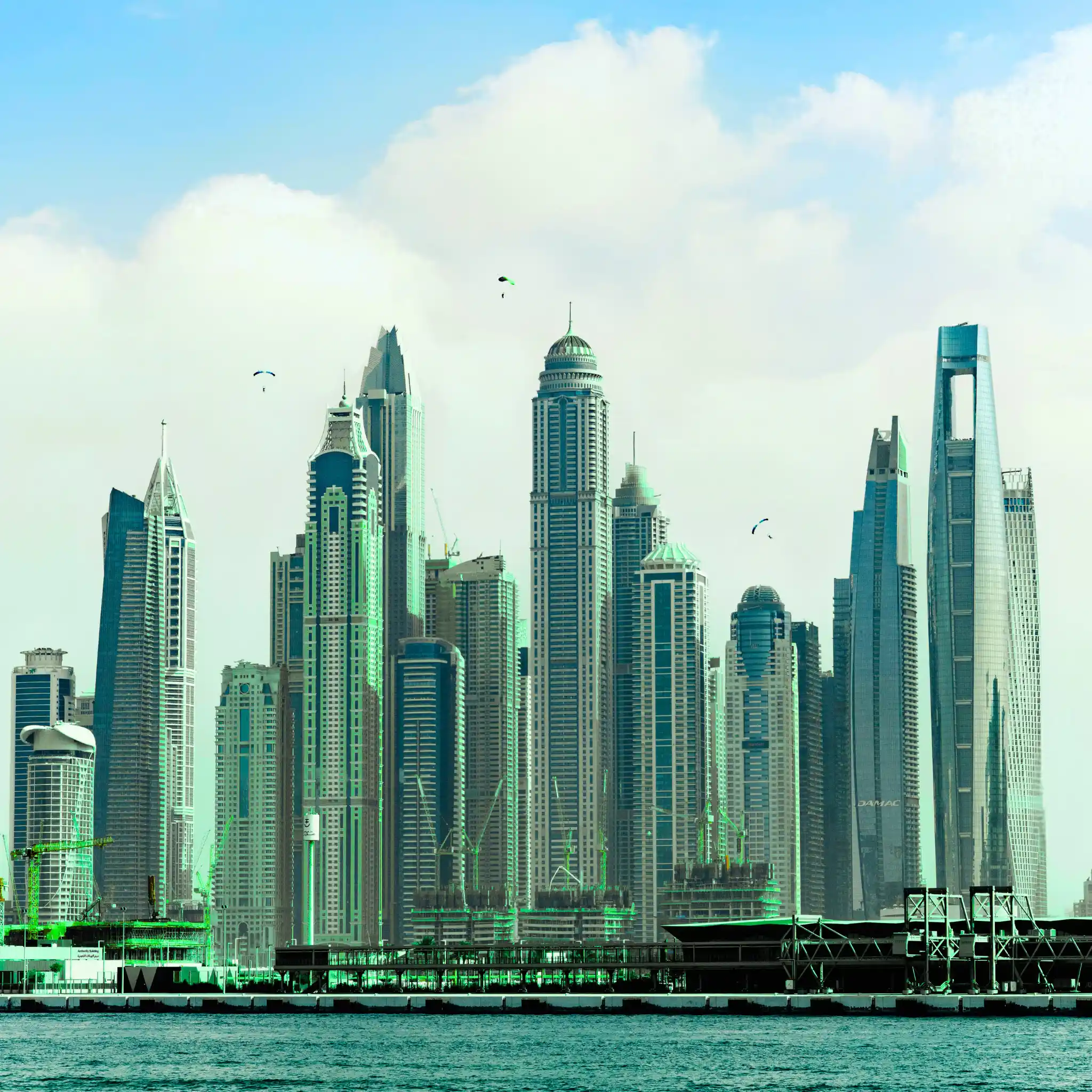
Here is what matters most: the UAE was well-prepared, acted quickly, and kept us safe. That meant that while the conflict ran at full force, Dubai's property market kept transacting.
According to Dubai Land Department (DLD) data, transactions reached AED 252 billion in Q1 2026, a 31% year-on-year increase in value, even as the conflict was at its most intense.
The market did not stop in April or May either. DLD figures show AED 28.51 billion in residential and commercial transactions across 10,218 deals in May 2026.
That is the signal most people missed while watching the headlines. Separating those headlines from the fundamentals has been the discipline that has served Dubai investors well across every previous cycle.
At Stake, we saw the same pattern from the inside. In March 2026, at the height of the disruption, our investors received a record AED 4.2 million in rental income, the largest monthly payout in our history.
During this period, we also funded our 600th property and crossed another huge milestone: We have now distributed over AED 200 million to investors since 2021.
GCC investors held firm, why?
One of the more important things the conflict period revealed is how independently Dubai's property market now behaves from international sentiment.
GCC buyers did not panic. They live in the region, understand the fundamentals from the inside, and have watched Dubai navigate previous shocks, so they recognised the buying opportunity with below-market value deals.
Dubai is a safe haven not because it avoids challenges, but because of how it responds to them. The city was built specifically for moments like this, ready for unexpected events.
Today's investors, broad and deeply regional rather than dependent on any single international cohort, is part of what makes Dubai's demand more durable than it was a decade ago.
This is a market driven by end-users and long-term holders, not speculation. That’s why it’s resilient.
What the people who know this market best are saying
I sat down with two of Dubai's most influential property CEOs: Lewis Allsopp, Founder and Chairman of Allsopp & Allsopp, and Abdullah Alajaji, Founder and CEO of Driven Properties. Between them they have over 40 years of real estate experience.
Watch the full conversation here.
Three things stood out.
1. The market never stoppedLewis said that at the worst point, Allsopp & Allsopp was down 80% on transaction volumes. However, by the time we recorded, they were back to around 60% of pre-conflict numbers, rising weekly, and projecting their best week in 10 weeks. Crucially, viewings had already returned to pre-conflict levels, which is the leading indicator Lewis watches most closely.
Abdullah confirmed the same trajectory at Driven, adding that this recovery was faster than COVID, where transactions took two months to stabilise. This time, it took two weeks.
2. The people who know Dubai best, boughtAbdullah's firm completed the acquisition of two buildings during the conflict, deals that had been in progress for over a year. The logic was straightforward: even assuming that rents could fall by 25 to 30%, the assets still yielded 7 to 7.5% net.
What matters is discipline applied to a high-quality asset at a discounted price.
3. On the peace deal specificallyAbdullah's view on what a sustained peace settlement means for Dubai was direct: when regional peace becomes durable, the risk attached to Dubai property adjusts.
The comparison he used was Singapore and Hong Kong. Those markets price at the levels they do partly because stability is assumed. Dubai has earned the same fundamentals, but the war elevated risk - once that is removed, there’s more room to grow.
The entry window that opened, and won't stay open forever
The conflict created softness in parts of the market, particularly affecting segments with weaker fundamentals and more subject to speculative buying and selling. It also created some lower entry prices in prime areas.
This follows what happened during COVID. The cautious move looked like waiting, however, people who invested in that window saw Dubai apartment prices rise around 90% over the five years that followed.
No one could have timed that bottom in the moment. The buying window was only obvious in hindsight, but what was important is that they acted.
As risks from the conflict ease, international capital will begin to return. The negotiation period still needs to play out and full certainty remains ahead.
Our team has been actively using this window to find below-market value properties for our investors. However, a cheap price is not the same as a cheap asset, and this is why we only select properties with investment potential.
If you were looking for a good moment to start, this is the time to pay attention.
What Dubai's history tells us
This is not the first time I have watched Dubai face a challenge. I’ve been here for the Global Financial Crisis, the oil and oversupply cycle, COVID-19, and now this.
The pattern is consistent: an initial shock, a period of doubt and softening, and then a recovery that outpaces what came before. The top 10 Dubai neighborhoods that have survived every shock since 2008 all share the same characteristic: they recovered faster and stronger than anyone expected at the time of the crisis.
The logic is not complicated. Global investors are looking for a jurisdiction where ownership is simple, the currency is anchored, and the path to long-term residency is straightforward - that’s why Dubai keep outperforming.
The fundamentals that drive that recovery pattern have not changed:
- A tax-efficient environment unmatched by comparable cities
- Rental yields that consistently outperform London, New York, Paris, and Singapore
- Regulatory transparency anchored by DFSA oversight
- Infrastructure commitment at scale, including the AED 34 billion Metro Gold Line and the continued DIFC expansion, both signals of a government building for decades
Today's buyer mix makes the recovery case stronger - Dubai is no longer dependent on a single nationality or investor cohort. It is broad, deep, and increasingly anchored by residents who have chosen this city for the long term.
What this means if you are considering investing now
The US-Iran peace deal removes the single biggest sentiment concern Dubai property has faced in the past four months.
As confidence returns and international capital flows back in, the entry points available today will narrow. When markets shake, real estate plays a different role from stocks or crypto, and that is precisely why investors who think in years rather than weeks tend to look at property in moments like this.
Building a second income stream has never been more relevant. The past four months have reminded every investor that relying on a single source of income, or waiting indefinitely for perfect conditions, carries its own risk. Every month of waiting is a month of rental income not earned, a month of potential appreciation not captured.
On Stake, you can start from AED 500. Fractional real estate gives you access to the same income-generating assets and the same market upside, without needing to commit hundreds of thousands to a single property.
So, what’s next for us?
We have been through four months of genuine challenge. Our platform kept running, our investors kept earning, and Dubai kept transacting.
The news cycle will move on, the fundamentals will not.
If you have questions about your portfolio or what this moment means for your investments, our team is ready.
I am proud of what our community has built through a difficult few months. I am excited for the next moves on the horizon - Stake continues to evolve, always better for our investors.
Thank you for your continued trust.
Rami Tabbara
Co-founder and Co-CEO, Stake
All Investments carry risks. Stake Properties Limited is regulated by the DFSA as an Operator of a Crowdfunding Platform in the UAE
This article provides analytical insights for informational purposes only. It does not constitute financial advice. All investments carry risks.